
TRENDS 2026, the year of industrial robustness
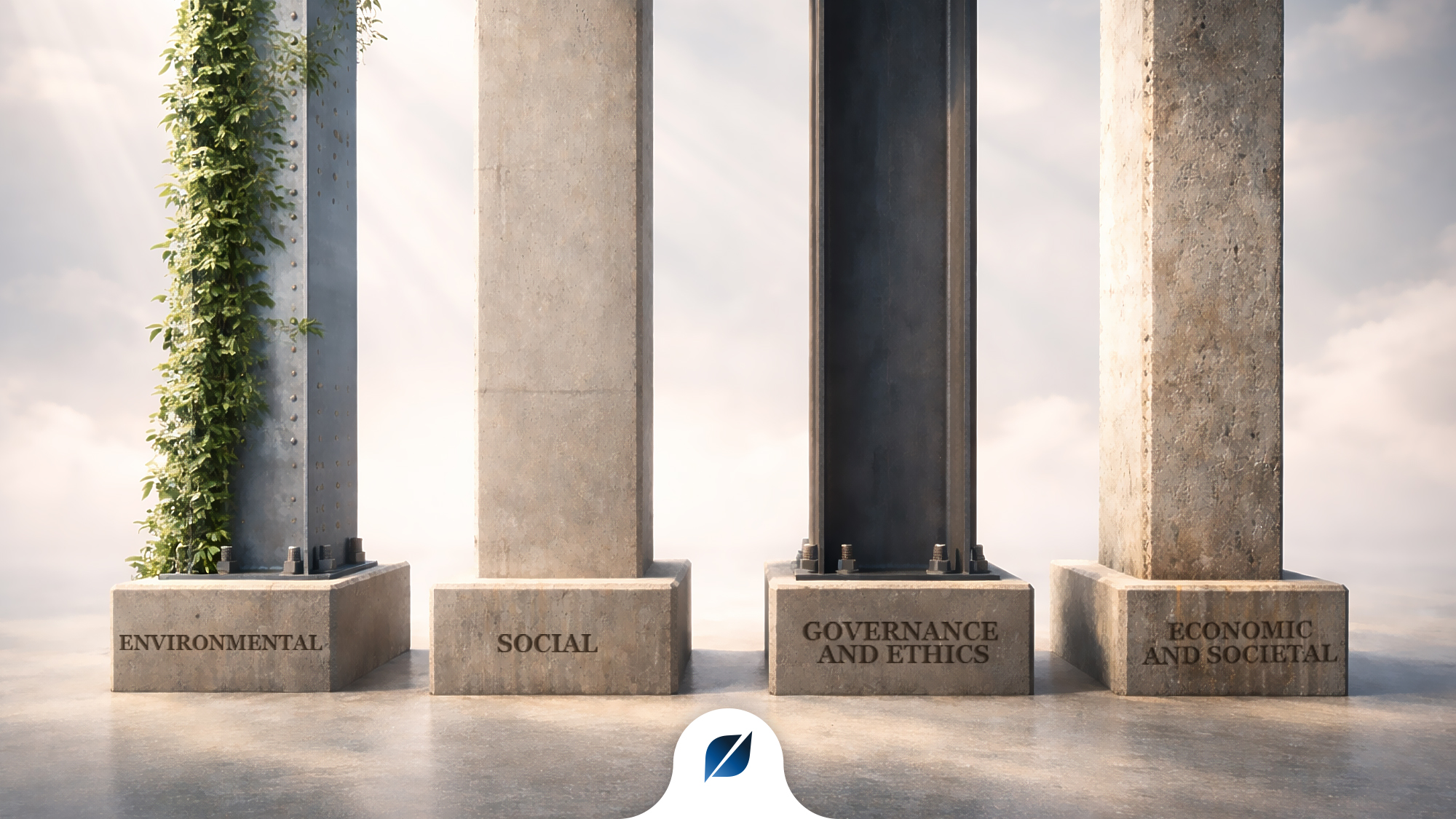
Four pillars shaping the European industry in 2026
Environmental pillar: from decarbonization to regeneration
This is currently the most advanced pillar, and one of the most demanding. In 2026, decarbonization is no longer limited to direct emissions. Companies are increasingly expected to address emissions across the entire value chain, from raw materials to end use.
Long-term climate pathways towards 2050 now include concrete intermediate milestones for 2030. For industry, this translates into sustained investment in renewable energy, energy efficiency, and the adaptation of production processes. The European Fit for 55 framework continues to structure this trajectory through ambitious and measurable targets.
Alongside climate, biodiversity is gaining strategic importance. Following the Montreal Agreement (COP15, 2022), the preservation of natural systems is increasingly reflected in policy and market expectations. The COP17 on biodiversity, scheduled for October 2026 in Yerevan, Armenia, will be a key milestone in this process.
Finally, circular economy considerations are gaining importance in industrial discussions. Reuse, recycling, and extending product lifespans are increasingly explored where technically and economically feasible. In parallel, water management, in a context of growing water stress, and energy efficiency are receiving greater operational attention.
Social pillar: supporting people through transition
In 2026, the social pillar increasingly centers on a key challenge: supporting change while limiting disruption. The concept of a Just Transition is gaining ground, with a focus on anticipating the social impacts of environmental and industrial change. This involves sustained investment in training, reskilling, and upskilling to ensure workforce continuity.
In an industrial sector facing multiple pressure points, talent attractiveness is also becoming a strategic consideration. Quality of life at work, mental health, and organizational flexibility are no longer peripheral topics, but factors that influence performance and retention. Companies are therefore paying closer attention to indicators related to gender balance, diversity, and inclusion, particularly at management and leadership levels.
Available data suggests a correlation between balanced leadership structures and business outcomes. For example, a McKinsey study indicates that companies with stronger gender representation in top management tend to report higher profitability levels. In 2026, workforce considerations are increasingly integrated into long-term industrial resilience strategies.
Governance and ethics pillar: from narrative to evidence
This pillar reflects one of the most significant cultural shifts underway. In 2026, expectations are moving away from broad narratives towards greater factual consistency. Stakeholders increasingly expect transparency, evidence-based communication, and a clear acknowledgment of both progress and constraints.
Levels of trust remain fragile. A survey ( “Mouvement Impact France / Harris Interactive”) indicated that a large share of customers question the credibility of corporate CSR claims. As a result, the response is becoming more technical and structured. Audits, third-party certification, and data traceability are gaining importance as reference mechanisms.
These expectations increasingly extend to the supply chain. Responsible purchasing policies are progressively built on documented extra-financial criteria. The extent to which suppliers are assessed, engaged, or certified on these aspects is becoming a governance parameter.
Economic and societal pillar: CSR as a lever for robustness
In 2026, CSR is no longer seen as a brake on competitiveness. It is increasingly used as a lever to support robustness, continuity and long-term positioning. In recent years, some companies have formalized their purpose in their corporate statutes, defining their role and responsibilities within society.
At the same time, dialogue at territorial level is gaining importance. Industrial projects are more frequently developed with attention to local contexts, involving exchanges with residents, local authorities, and other stakeholders. This contributes to social acceptability and supports operational sustainability. In this sense, economic robustness is also linked to the quality of local anchoring.
SEAM: a structuring framework for 2026
In the context of structural change, industrial companies need clear and reliable reference points. Complexity is increasing, requirements are overlapping, expectations are multiplying, and timelines continue to tighten. It is in this environment that SEAM finds its relevance.
SEAM is a structured framework, designed for industry, to help organize action, establish a common vocabulary, and support progress at a pace compatible with operational realities.
On Scope 3 in particular, SEAM provides a clear and recognized methodology that helps frame exchanges with customers and brings consistency to decarbonization pathways. The SEAM Carbon Footprint Project forms part of this long-term approach, offering practical tools and supporting companies in structuring their own footprint assessments.
In a context where corporate statements are increasingly examined, SEAM contributes to credibility by providing an independent and structured reference. Even where regulatory deadlines are deferred, companies that engage early are better positioned. SEAM makes it possible to prepare for ESRS requirements through a pragmatic, action-oriented approach, without adding unnecessary administrative complexity.
2026 will not be defined by declarations. It will be shaped by structuring choices.